Sunday, August 30, 2015

South with the Bears and Whales and a Very Tasty Halibut

August 21, 2015: Our Swimming Bear

I think the pictures tell the story here ... except for the part about our surprise and wonder! We have never seen a swimming bear in these waters. Today we are treated to the sight of a Kermode bear swimming from one island to another, right next to our anchorage.

When I first see the bear it is already in the water swimming.
It reaches the point of the islet behind which we are anchored and climbs out of the water.

With it's huge paws, it pads purposefully across the rockweed. This isn't the bear we saw last year...
We watch it's progress carefully to see if its a male or female. Inconclusive ...


Our beautiful bear stops for a sniff and a pose before continuing on up into the woods.

August 19, 2015: Wild Birds, Wild Beaches and Patrick’s First Halibut

We’ve wanted to come back to the Estevan Group of islands since our first visit several years ago. It is a wild part of the coast, pristine and seldom visited by cruisers. This time, with strong weather in the forecast, we choose the south end of the archipelago for its compelling combination of a protected anchorage, nearby wild “west coast” beaches and a reputation for great fishing. 
We've tugged on the anchor to ensure a good set, shut down the engine and are enjoying cocktails on the taffrail when we notice a big osprey making huge, lazy circles in the sky above our mast. It lands on the tip of a nearby dead tree to surveys its domain and pose for pictures before resuming its restless circling. A gaggle of gossiping Canada honkers graze on grass and wrack nearby. The prehistoric-sounding cries of sandhill cranes can be heard; we don’t see them but the sound reminds us of home. The sky glows with sunset colors. Red sky at night ...
 
We enjoy a quiet night and awake to sunny skies. My first thought: “Beachcombing!” Patrick’s first thought: “Fishing!” It is almost low tide. Patrick drops me off at a beach that looks like it has potential. My goal: more glass fishing floats to join the ones I found last year. They happily float around in our swimming pool, a much less stressful environment than the wild Pacific Ocean or, worse yet, the reefs and rocks of this merciless coast.
 
Watching for underwater boulders that could damage the inflatable’s propeller, we gingerly approach shore. I sit balanced on the bow, riding the waves with boots sticking out ahead to feel for the bottom. The first couple of steps are always the worst. Awash in the swell, the rocks are covered with treacherously slippery seaweed and algae. The moment when I transfer my weight from the boat to the rocks is the hardest. That’s when I have the greatest chance of slipping—and soaking myself. This time it’s a success. I hop from boulder to boulder on the way to the messy bulwark of gigantic drift logs near the high tide line where flotsam and jetsam get tangled and caught. Hopefully a target-rich environment.
I find a battered orange laundry basket with Kanji characters, then use a stick to turn over a weathered shoe. It’s a Nike. Is it from the famous “lost container” that years ago fell off a cargo ship and deposited many thousands of athletic shoes all along this coast?
Then I find something wonderful. It’s the dining table of a coast-dwelling creature, perhaps an otter. I have found them before, always on a big, stable log near the very top of the beach, one that has been there a long time. Sometimes I’ll find little piles of bleached-white, butterfly-shaped chiton plates, or the lavender-colored shards and spines of a sea urchin. Here, I find a scattering of gleaming iridescent abalone shells, perfectly clean, turned up and shining in the sunlight. Somebody has had quite a few abalone feasts here! I crawl, climb, slip, slide and scoot my way around and over the logs, thinking about all of the happy gym-class hours I spent on the balance beam. This is sort of like that except these logs are uneven, tilted, often tippy, and I’m wearing clumsy gumboots.  A bright colorful spot catches my eye. Nestled cozily on a log is a vivid orange flower (artificial.) How did that get here?? Where did it come from?
 
No glass floats this time, but it’s time to head back to Tenacious. I find a good spot to
rendezvous with Patrick and the inflatable: big flat rocks with a sandy patch in front for an easy approach. I shift my balance and half-topple into the dinghy, giving a final shove with a booted foot to send us out into the channel. A surprise awaits me on the floor of the dinghy. There, still flopping half-heartedly, is a beautiful small halibut – Patrick’s first! It’s the perfect size for us, since we don’t have much freezer space and nobody to share it with out here. We will feast tonight and still have several meals to look forward to. Hurray for halibut! Hurray for the halibut catcher!

August 16, 2015: That’s Close Enough, Mr. Whale

Traveling south in Estevan Sound I notice a whale ahead, rolling and splashing with its pectoral fins. We adjust our course so as not to come too close while we watch its antics. We have seen this behavior before and wondered about it. Is the whale stunning food fish with its slapping fins? It is using its fins to scoop fish toward its mouth? Or is it just horsing around and having a helluva good time on a nice day? Hmmm. More study required.

Patrick shifts into neutral and we slow to a drift, watching and wondering as the whale splashes and rolls. Finally, it dives, leaving us with a pretty wave of its massive flukes. A minute passes. We’re thinking  our private whale show is over when we hear a blow off our stern. The whale is back and clearly moving toward us. 

There is nothing we can do -- we are adrift. The whale will be in control of this encounter. He surfaces again, this time within a few yards of our port quarter, moving parallel to our hull. This whale is BIG. And it is very CLOSE! He sinks down I notice a line of large bubbles forming alongside. It looks like something is boiling down below. The whale turns right and swims underneath our keel. Crossing to the 
starboard side we watch for the whale to surface. He blows right next to Patrick where he stands on the companionway next to the cockpit. Jake and Simon are watching from inside, eyes huge and ears pricked at the explosive sound of the whale’s blow. It stays near the surface and passes behind our stern just under our davit-hung inflatable (yikes!) and continues to circle back to our port side, once again blowing bubbles. For a second I think, “It’s bubble-netting Tenacious!” but realize that it is probably bubble-netting and feeding upon a school of fish that are ‘hiding’ in Tenacious’s shadow. Another circle and the whale leaves us with a farewell flourish of its flukes. We do love our visits with whales, but that was close enough!


Friday, August 14, 2015

The Man Who Fell From Heaven, Intertidal LIfe and Whales That Fish With Nets

August 8, 2015: The Man Who Fell From Heaven

What a summer! Ever since we set sail in June we have had what I call 'Goldilocks Weather.' Day after day on the south and central coast we roasted under mercilessly sunny skies Like Goldilocks tasting the three bears' porridge we said, "This is TOO HOT!" We continued north and were plagued by a relentless series of  low-pressure systems bringing seemingly endless days of cold and rain. We said, "This is TOO COLD!" Every so often we get a day that is "JUST RIGHT."

At this moment those days seem to be few and far between. Unlike Goldilocks, we can't run out the door when the bears come home. We tough it out, whether we strip down and clip a little 12-volt fan to the door of our cabin to blow away the heat of the night, or add wooly socks and a warmer, waterproof jacket when it's time to  leave the relative comfort of the cabin or cockpit to go on deck and hoist the anchor or go ashore. Lately we are alternating between cold rainy days and cold damp days.

That said, we must maintain perspective, reminding ourselves that we are sailing in the Great Bear Rain Forest (emphasis on the Rain.) Today we don climate-appropriate clothing and launch the dinghy from our anchorage in Pillsbury Cove, across from the busy deep-water port of Prince Rupert, BC. Our destination is one that has eluded us in the past: we are seeking a petroglyph, a rock carving, locally known as The Man Who Fell From Heaven. We searched for it a few years ago when we were last in this area but didn't find it. This time we have a bit more information about where to look.

Our course is treacherous with reefs and rock outcroppings that are more or less visible depending on the tide level. In an area with 24-foot tides, every hour can mean a difference of 4 feet -- the difference between passing safely over a rock,or losing a propeller. Needless to say in an unknown area, Patrick stands in the dinghy and steers with a handle extension, so he can see ahead.

We land safely on a sandy beach near where we believe the petroglyph might be. This looks as if it might have been the site of an old village. Patrick clambers along the outcroppings near the high tideline and finds our objective: The Man Who Fell From Heaven. Life sized, pecked out of the bulwark pf sedimentary rock that protects the land from the sea, we observe this queer thing. It is unlike other petroglyphs we have come across, most of which feature symbols and images of stylized and fantastic creatures. This is clearly a human shape,  concave, legs and arms splayed. It really does look as if a human fell to earth, leaving a mold of his (or her?) body on the rocky shoreline. We hustle back into the dinghy and push away from the beach as another squall passes overhead, all the while speculating about this unusual petroglyph. Another mystery on this coast! And another glad return to the cozy warmth and shelter of Tenacious. Next stop: The Prince Rupert Rowing and Yacht Club tomorrow!

August 2, 2015: “Clearly” a Special Place


We Seeking a new anchorage, we make our serpentine way through the jigsaw puzzle of islets and rocky outcroppings that is Ala Passage. Showers are in the outlook but no high winds, so we tuck into the little nook just west of Clear Passage in the “Math Islands.” We are snugged in between Sine and Cosine Islands. Tangent Island is nearby. I'm guessing whoever named these islands was working on their charting and navigation skills.

We have little trouble setting the anchor, though we drag a bit before it catches on the rocky bottom. As the boat moves with the wind and currents we hear our beefy 3/8” anchor chain rattling over the rocks. Patrick deploys a rope “bridle” on the chain, stopping the transmission of the grating sound into Tenacious's hull. And so we enjoy a quiet night. The morning brings us a minus tide and we venture out in the inflatable to reconnoiter Clear Passage.

The variety and volume of intertidal life leaves us breathless. We see yards and yards of the undulating fronds of bull kelp hosting raucous parties of tiny, needle-like fish and kelp crabs. Above the rocky tide line festoons of uncomfortable-looking white anemones dangle, seemingly stretched to the breaking point. Their luckier underwater brethren wave translucent tentacles lazily in the crystalline water.
There are three different kinds of jellyfish floating. On the bottom, the large, brightly colored plumes of ‘sea pens' are scattered liberally across white shell patches, looking for all the world like old-fashioned ostrich feather quill pens, except they are bright, almost fluorescent orange. A patchwork of colorful sponges, corals, algae and seaweeds quilts the seafloor, draped with the fat spiky bodies of sea cucumbers and sprinkled with several species of sea stars. Closer to shore a brilliant red globe about the size of a softball catches
my eye; a stunning example of a white-speckled rose anemone.

In the outer reaches, the  rocky reefs are studded with spiny red, purple and green sea urchins in sizes that range from tiny to dinner plate. We hang over the sides of the boat, enthralled, dazzled. Drifting along, we eagerly point out each new submerged wonder to one another. We will surely come back to this captivating, life-filled place. (Note: sea pen photo not mine.)

July 28, 2015: Whales That Go Fishing With Nets

Wright Sound and Grenville Channel are always great places to look for whales. Today our route takes us to the intersection of the two. To our delight, it is not long before we see the heart-shaped spout of a humpback whale near the rocky shoreline. As I race for the video camera, Captain Pat brings Tenacious in cautiously, staying far enough away that the whale is not disturbed, then shifts into neutral.
Look at the circle of bubbles!
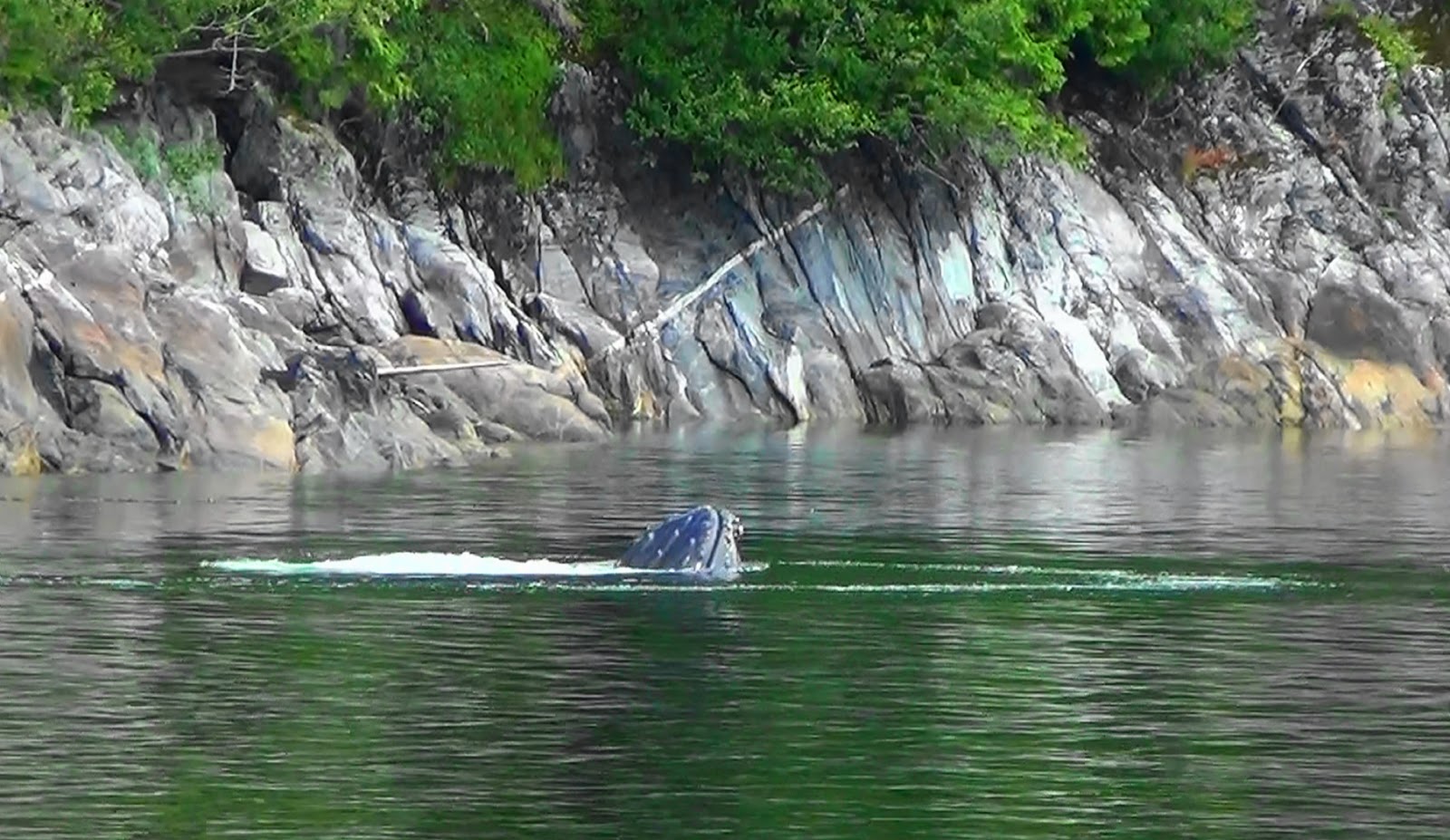
In a twinkling I am on the bow, camera at the ready, scanning the water for signs of the whale. It is making its way slowly along the shoreline. I notice what looks like the line of a tide rip, a strip of foaming water on the surface. It takes me a few moments to put together what I am seeing. The whale is swimming underwater and blowing bubbles. With the camera I follow the line of surfacing bubbles. They form an ellipse. When the circle is completed, the whale surfaces in the middle of the ring of bubbles, its huge mouth agape to capture the small fish trapped inside the “bubble net” it made. It blows once loudly, exhaling and inhaling through his large blow hole, then dips its head below the surface inside the circle once more, probably to snatch another mouthful of

confused and swirling fish still trapped in the bubble net. One more blow and the whale again dips its massive head, the curve of its back angled sharply downward. The distinctive “knuckle” of its dorsal fin submerges, followed by the balletic curved arch of its back and tail. Our last glimpse is a slow, graceful wave of its magnificent flukes, revealing distinctive twinned patches of white on the underside.
 There must be an abundance of food here; the whale makes net after net with bubbles, lunging through each net's center for mouthfuls of the sea's bounty. This whale seems to have a pattern of feeding through each bubble net twice --two gulps-- before blowing a new net a few yards away.

Finally we must leave this busy and talented leviathan. I look at Patrick and think about how to describe my feelings. “That was amazing,” is all I seem to be able to come up with. He silently nods his agreement. I think about it some more. “That was truly amazing.” I think it will be some time before I will stop smiling. Sometimes there just aren't words ... 
https://youtu.be/NKXckJlvfXA
(YouTube video of our whale bubble net feeding... 2:54)

Friday, July 10, 2015

A Potlatch, Orcas and a Crow War

June 30, 2015 Bella Bella Potlatch: Celebrating a Peace Treaty

More good luck! At Shearwater Marina we hear there is to be a potlatch nearby and we are invited. We leave a little early and take the SeaBus for the 2-mile ride over to Bella Bella where the event will be held. That way we have a little time to explore the village first.

The Chiefs Dance (note the Littlest One!)
We admire the carved poles and ask around about the potlatch. A young man fills us in on the details and invites us to the Elder's Hall for lunch before the main event. There is a buffet of home-made traditional foods, including baked salmon, smoked salmon, sea asparagus salad, herring roe, roe-on-kelp and even eulachon oil, a traditional staple of the First Nations on this coast (and an acquired taste.) It is the oil skimmed from the fermented and crushed bodies of eulachon, also known as candlefish, due to the extremely high oily fat content of their bodies. We sit down to enjoy our meal and find that we are one table over from Guujaaw, carver, historian, activist and former president of the Council of the Haida Nation; and David Suzuki, environmentalist and host of the well-known PBS series "The Nature of Things." You run into the most interesting people up here!
Guujaaw Drumming
After lunch we mosey over to the community center where the crowd is gathering. Many representatives from Haida Gwaii have traveled to Bella Bella for this event, and stayed with Heiltsuk families this week. The potlatch is set to begin at 2pm, but nobody is looking at their watches. 

Yesterday a peace treaty was signed between the Haida and Heiltsuk Nations. It formalizes a verbal agreement made between the two tribes about 150 years ago. Tradition demands that all important business such as this must take place before the community, and so a potlatch is held. Gifts are always given to all who attend the potlatch, as payment for witnessing the business that has taken place. Attending the potlatch means that you support what occurred and will always remember the transaction. You are "paid" for witnessing with potlatch gifts.

The Eagle Dance
 
Speeches and gift-giving are interspersed with traditional dancing, singing and drumming. Guujaaw is given an award and dances to say 'thank you.' The traditional chiefs dance in their button blankets and elaborate ermine-covered headdresses filled with eagle down (a symbol of welcome and peace.) The children perform traditional dances that are handed down through the generations.

The Sasquatch Dance
 
The dancing continues, always accompanied by singing and rhythmic drumming using what look like small clubs on a cedar log. I always get a kick out of seeing the drummers holding their young children, even babies, as they drum. These little ones will grow up knowing the ancient songs of their people! Stomachs begin to growl as the dinner hour approaches. The Heiltsuk women have prepared tray after tray of food, and are serving it onto hundreds of paper plates, laid out on long tables. The teenagers are tasked with serving dinner to the hundreds of people in the hall, carefully carrying two fully loaded plates at a time. All are served surprisingly quickly and we enjoy our plates of chicken nuggets and vegetable chow mein. It's delicious!

After dinner the very special 'owned' dances are performed. In these oral cultures that had no written language, names, stories, carved masks, songs and dances are valuable property and are bequeathed as such. Stories told by the songs, dances and masks may be creation myths, or tales of an ancestor's encounter with a supernatural being, or other family history and lore. The owner of a particular dance is the only one who can perform it, unless he or she gives permission to someone else.
 

New mask and dance celebrating the peace treaty.
We are witness to Sasquatch, Eagle, Bear, Raven and Whale dances, among others. The dancers tell their story and bring their masks to life with their interpretations of the creature they portray. The Eagle  opens and closes its feather-edged wings and dips and soars around the dance floor. The Bear bends low to the ground and them reaches up and out to shred the air with his clawed forepaws. The clever Raven walks with his wide-legged stride, cocks his head and clacks his long beak, for all the world like its living cousins. The Whale mask is a real feat of engineering. Carved from cedar, it has to be at least 5 feet long and balances on the head and shoulders of its (presumably very strong) dancer. The mouth opens, the dorsal fin can be raised and lowered. With an Eagle perched on its head, the whale dives and surfaces in its passages around the dance floor, emitting an eerie moan. I wish I knew that story!
 
Whale Dance
At long last the evening draws to a close. We happily receive our potlatch gifts of commemorative t-shirts, copper prints of the artwork that was commissioned for the treaty signing, and stainless steel water bottles with the same artwork. Along with everyone else here, we are now officially obligated to bear witness: the Haida and the Heiltsuk will not make war on each other any more. 


June 18, 2015 Performing Live on Queen Charlotte Strait: The Orcas!

We have just left Blunden Harbour on our way to Port McNeill for fuel and supplies. Patrick is belowdeck and I’m on watch when I notice a splash off in the distance. We are traveling toward it, no need to change course. Yes—there is another splash. It’s probably a whale. I call Pat to come topside with the video camera.

We cautiously approach what turns out to be a pod of orcas, and oh boy, are they having a good time! We shift into neutral about 100 yards from them, and just enjoy the show. One young orca seems to get a big kick out of the splash made when it slaps its tail on the water; it does it over and over. Several of them pop their heads up out of the water to look around, spy-hopping. A big male porpoises through the pod, arching his huge, beautiful black-and-white body almost out of the water.

What strikes me about the orcas is how close together they are most of the time. Though always in motion, they are intimate, touching, constantly in contact with fins and tails, sliding their sleek rubbery skin alongside each other even while rolling and dipping, rising and splashing. Its so easy to feel the affection they have for one another. Occasionally the big male moves off in another direction, soon to return to the group. Each time he comes back he is joyously greeted with whistling calls and welcomed back with more exuberant rubbing, touching, rolling and splashing. They are such a beautiful family.

As we silently drift, the pod approaches us. Their gusty blows are explosive and we can clearly hear their vocalizations. Squeals and high-pitched cries alternate with bubble-blowing and a funny sound that reminds us of a  Bronx cheer. I tell Pat, “They’re giving us the raspberries!” Jake is on deck and intrigued, watching the huge animals diving and surfacing. They disappear for a few moments and we begin to wonder if our orca show is over. Suddenly there is a loud PFFFFFTTTT! The huge head of the big male surfaces a few feet from our starboard side, right next to Jake and Patrick. We are all startled—Jake leaps up and races to safety down below as we laugh. True to form, two of the other orcas surface nearby, close to the big male.  We can clearly see their distinctive white “saddles” underwater. Patrick tells me he could have counted the teeth on the one that scared Jake.

They amble past us and continue their antics. We are thrilled when one of them launches its huge body completely out of the water in a breach, coming down with a gigantic splash. We say farewell to the orca family, thankful for their visit, grateful for their wild, loving presence in our world.

June 21, 2015 Jake and the Crow War


It may never be known who started it, but in the war between Jake The Cat and the crows of Port McNeill, we believe Jake has had the last word …

We are getting ready to leave the dock at Port McNeill. The morning bustle of topping up the water tanks, picking up the power cord and generally preparing for departure tells Jake this is his last big chance at shore leave. He casually jumps off the boat, sniffs the dock lines, checks out the neighboring boat and strolls shoreward. Fifteen or twenty minutes go by and it’s time to leave. A quick check reveals Jake’s absence. (As usual, Simon is the GOOD kitty!)

We are tied up at the very end of B Dock finger. I walk toward the main dock calling for Jake while surreptitiously peeking at the decks of neighboring craft along our finger, in case he is visiting other boats, one of his favorite things to do. I get to the main dock and still no Jake. Usually when he hears me he, he comes running, meowing excitedly to tell me all about what he has done and seen, and to claim the extravagant petting, scratching and praise he receives when he answers my call. I have to decide which way to go,  either left to the rest of the huge network of dockage, or right toward the ramp to shore. I sigh. I know Jake, and Jake would head for land.
 
The Crows Yell at Jake
At the top of the dock ramp is a small parking lot filled with cars. I begin calling Jake. A boater asks, “Are you looking for your dog?” “My cat,” I reply. Then I hear the raucous caws of a dozen crows having some sort of squabble. They are quite agitated. Still calling for Jake, I walk between the cars toward the back of the parking lot. There, standing on his hind legs up against the back wall, is Jake, using his front claws to swat at the gang of crows who are dive-bombing him from the surrounding trees. They are clearly unhappy with the presence of a cat in their midst. They clamor for blood! They swoop and dive! Jake hears my call and runs toward me, then ducks under a car. The crows are relentless! They fly low and hunt for their sworn enemy on the ground. Spooked, Jake moves from car to car. I can’t follow him quickly enough to catch up.
 
By this time, other boaters have figured out what’s going on. They pitch in and help spot Jake from different vantage points. “He’s under the blue pickup!” shouts one. “He’s next to the dumpster!” calls another. I’m scrambling between cars, trying to get close enough to rescue Jake. Finally a woman calls out, “He’s heading down the dock!” And sure enough, he is. He races down the ramp with a squadron of crows on his tail – almost literally. They squawk and scream and dive on Jake all the way back to Tenacious. 
Jake Keeps an Eye on the Crows
By the time I catch up Jake is up on top of the bimini, in a stare-down with two crows that are perched on our spreaders. The crows loudly express their highly uncomplimentary opinions of Jake and all cats. Their meaning is clear and war has been declared. Jake stands firm, not moving from his staked-out position. They keep up their harangue until finally, when Patrick starts our engine, they fly back to their (cat-free) parking lot. Jake has prevailed in this battle.
 
We wonder what will happen when we return to Port McNeill in the fall.


Sunday, August 31, 2014

Bear Blanc and Beachcombed Treasures, August 31, 2014


Princess Royal Island – August 23, 2014
This morning begins for me with more tentative rain showers spattering the hatch cover over the bed. Patrick is already up and on the morning Net – the Great Northern Boaters Net that begins at 7:30 each morning and helps cruising ham radio operators stay in touch. It’s a dawn low tide today and he is watching the shoreline for bears. When the Net is finished I know it’s my turn to crawl out from under the warm covers and take over shore watch. Princess Royal Island is home to the rare, and even more rarely seen white bear the local First Nations people call the Spirit Bear. We have come here in hopes of seeing one.

I pour a second cup of coffee and with my latest paperback novel in hand, get comfortable in the cockpit, scanning for bears at the end of each paragraph. I have only turned a page or two when I see something moving along the rocky bank before me. For a second or two I am frozen in place, not believing the evidence of my own eyes. I snatch up the binoculars and glass the rugged shore below the trees at the high tide line. Yes, a white bear is walking over the rocks in our direction.

In my excitement I have to remind myself not to shout and startle the bear. Thank goodness Patrick has already dropped the dinghy from the davits and has it tied up alongside Tenacious, all ready to go. My voice is shaking when I duck down below to tell Pat what is out there. I scramble below, trying to think of what I’ll need to take: video camera, warm jacket over my pajamas, life vest…anything else??? Yes—we must call our friends Noreen and David, anchored nearby, on the VHF radio and alert them to the sighting. It is amazing to be lucky enough to see one of these bears, let alone to be able to share it with good friends.

Quietly, so as not to frighten the bear back into the woods, our two dinghies slowly putt toward the shore, ahead of the bear. He stalks along calmly in our direction. Full-grown and healthy, in the prime of his life, his thick, lush fur is the color of heavy cream with rusty-toned highlights. His paws are muddy and his claws are long. He walks pigeon-toed. After a few minutes he is close enough that we can determine, with certainty, that he is, indeed, a he, and he seems to have a plan in mind, and knows where he is going.  He grazes on sedge grass for a bit, then continues along the rocks. At one point he ducks down and twists his head to reach under a fallen log for a tempting cluster of black mussels. He tears off a few mouthfuls. We can hear him chewing as his strong jaws make short work of his crunchy, juicy treat. He moves up into the forest and Patrick points out that he is just taking a shortcut across a point of land. We re-position our dinghies for when he comes out the other side. He pops back out as predicted and we continue to gaze at this beautiful creature, moving sure-footedly over the seaweed-covered rocks. The Spirit Bear is a genetic variant, not an albino, of the American black bear, known as ursus americanus Kermode, or Kermode (Ker-MO-dee) bear, for the man who identified the sub-species. I still prefer “Spirit Bear.”
The white bear stops, looks around, poops, then yawns widely before continuing toward the top of the bay where the salmon are jumping. He walks up the creek and finally disappears into the woods.

We are completely enchanted. Our first Spirit Bear!!!
Video (about 4 minutes):  http://youtu.be/Wbp4gs7oaOs

                              Beachcombed Treasures: West coast, Haida Gwaii, August 17, 2014
Sea lions check us out as we head toward SGaang Gwaai
Patrick has just dropped me off at the head of a long, narrow inlet on the Pacific coast of Haida Gwaii. This is “the outside,” wild and largely uncharted. We have wanted to get out here since we came over to Haida Gwaii but didn’t have good enough weather to try it before. Even today we had to brave 6-foot seas (with Jake The Cat feeling the need to ride it out on deck instead of safely down below, probably shortening my life in the process…)  We have heard this is a good year for beachcombing, and for years my dream has been to find one of the beautiful old hand-blown glass fishing floats from Japan. they haven't been used there since the early 1970s when they were replaced by plastic and Styrofoam ones. We have met fellow cruisers who have found glass floats out here. Today will be my chance.
 

Even from our anchorage, far from the shoaling flats, we could see colorful plastic fishing floats washed up along the tide line, so my hopes are high. Ever since we dropped anchor I have been itching to go beachcombing.
 
I wade ashore to find I am walking on the dried husks of thousands of dead velellas, the "by-the-wind sailors" brought by El Nino. Before I knew their true name I was calling them 'sailing jellyfish.' We haven’t seen them before but enjoyed sharing the seas with rank upon rank of these tiny fellow sailors as we headed south from Queen Charlotte City a week ago.  I brought a few aboard and they are beautiful! Their structure reminds me of Chautauqua and our Sunfish sailboat in miniature—an oval “boat” about 2 inches long with a low parabola of transparent “sail” that
extends fore to aft.   Some are completely transparent, with a texture like firm unflavored gelatin, and some seem to have a beautiful blue “boat” with a clear sail. Each tiny body is beautiful with concentric rings. Once they are driven ashore to dry out, they crunch underfoot. It sounds as if I am walking on potato chips. Aside from that the only sounds are those of kingfishers and tiny brown shorebirds, watching me curiously and peeping away. They are surprisingly unafraid and let me approach quite closely before they flit off to another perch just a few feet away, cocking their heads to see where I might go next.

 I see deer tracks and their scat first, then the deer themselves, also calmly browsing on the salty fronds of kelp washed ashore.  They pay no attention to the two-legged creature temporarily sharing their domain. They have boundaries however, and I find I can’t get much closer than 20 feet before they glance up from their grazing and take a few steps away. Still, I get the feeling they don’t see many humans. They have no fear of me.
Flotsam and jetsam are scattered everywhere from the waterline all the way up into the
woods far above the high tide line. As I traverse up and down the shore I find every kind of bottle; plastic ones for water, shampoo, Sriracha sauce, soda and myriad others with labels in English, Japanese and a few other languages I can’t positively identify. Surprising to me, I also find lots of glass, mostly alcohol bottles, including some very pretty ones that I think are sake bottles from Japan. I inspect each one for a message inside. I am repeatedly disappointed but hope springs eternal… I can’t help but wonder how much of this stuff was set adrift by the huge tsunami that wreaked such havoc in Japan a few years ago.

There are toothbrushes, hairbrushes, combs and medicine bottles. There are an intriguing number of hardhats, mostly yellow or white. I find two portable toilets (both sans seat), a large portable propane tank and any number of fishnets  and ropes impossibly tangled in the drift logs. I cross paths with ping pong balls, a golf ball, several still-very-bouncy rubber balls, two soccer balls and a red, white and blue basketball. I find automobile wheels – not just the tires, but entire wheels. Then I find a portable toilet seat --presumably from one of the toilets I found earlier. And a complete set of plastic shower curtain rings. A Styrofoam model of a lighthouse makes me laugh. And wedged under a log, there is a very waterlogged leather briefcase, empty but complete with combination locks and filing compartments. Someone decided to chuck civilization and return to Nature?

Then I notice how many different kinds of footwear I’m seeing. I find everything from flip-flops and sneakers to sea boots in a wide variety of sizes and brands. The sheer volume of footwear is actually fairly alarming. I really hope all of these shoes were accidentally left on beaches or something equally benign.

And everywhere, large and small, plastic and Styrofoam, some netted and some not, with or without tether, I find fishing floats. There area few big black ones that could serve as a bathtub if cut in half. There are head-sized orange ones that look like globes with latitude and longitude lines and Japanese characters, little blue ones with “ears” that look like Mickey Mouse and basketball-sized aluminum ones that are scuffed and scarred as if by battle. Floats are all over the place. We have even seen them adrift, sometimes free and sometimes mired in a floating snarl of kelp . But I am on the hunt for the older, pre-plastic glass floats.

I find my first one nestled in beach-washed kelp and the dried carcasses of sailing jellies. I pause to enjoy the moment of my first glass float find. It is a pretty shade of pale blue and the pontil mark on the bottom, where it was blown, is thick and a darker shade of blue. The glass is worn and looks almost frosted.

The second one I find is quite astonishing. It is larger than my head and still has the remnants of the knots that tethered it to its fish net many years ago. It has clearly been at sea for a very long time. A Japanese oyster has grown into the pontil mark on the glass!

This large one is green, and so big that I'm not quite sure how I'm going to carry it along with me as I continue the hunt. Luckily I brought a plastic grocery bag with handles and it just fits. Subsequent finds will have to be stuffed into my pockets!

My luck continues and when I run out of beach and the tide is squeezing me between its encroaching wavelets and the treeline, I have 11 glass floats sized from about 3 inches across to the really big one, about 12 inches, in various containers and pockets about my person.

Another one of my sailing dreams has come true this summer. I love the "outside!"


Wednesday, July 30, 2014

A Grizzly Mama in Khutze Inlet, July 29, 2014

I wake up early to the sound of raindrops pattering on the plexi hatchcover just above the bed. Another rainy day in Khutze Inlet anchorage. Patrick has already suited up in his off-shore foul weather gear and taken the dinghy out to brave the rain in pursuit of our dinner. The Dungeness crab are many and quite large in Khutze Inlet, and with Patrick's skill and a little luck, we'll dine well tonight. I crawl out from under the warm covers, trying not to disturb Simon and Jake, who have each nested next to me, one under my arm against my side, and the other in the crook of my knees. I attempt to minimize jostling and they are instantly asleep again. It's time to get dressed and get out there to look for bears on shore.

Still in my flannel pajamas, I step into my sea boots, pull on my rain slicker and make my way out to Tenacious's rain-soaked teak deck, Binoculars in hand, I scan the shoreline near the waterfall to find Patrick. He is in the dinghy near the base of the falls where the big crab gather on a rising tide. There are at least half a dozen bald eagles nearby, watching him, some with the white head and tail of mature eagles, and several with the speckled brown feathers of youngsters. A couple of them seem to be having a minor argument over a scrap of fish. Another one is trying to dry his wings, reminding me of our Florida anhingas.

From the deck I scan the bay and shoreline. Between the raindrops my binocs pick up a number of harbor seals patrolling for fish, squabbling sea gulls chasing after a school of small fish and other sea birds with rain running off their feathered backs. It's just after low tide and the mud flats are wide and studded with ancient stumps, boulders and stray logs. Just behind the flats is a tidal estuary that goes on for miles, with sedge grass, clumps of trees and meadows full of wildflowers. In the distance is a mountain range, snow fields still capping several of the peaks.

Long, low ribbons of fog stream up the estuary as if powered by invisible breath. I train the binoculars along a point of muddy land that runs along the river outlet. Out of the mist I see movement. A ray of sunlight illuminates golden fur. I have spotted a grizzly bear, walking out of the fog toward the water. I can't move. I watch in awe as she calmly lumbers  toward me, when I see something moving behind her. One, two and then
three cubs are following in her giant footsteps. I grab the video camera, eager to capture their images before they move on. They seem content to linger on the flats, so I radio Patrick with the news of a grizzly sighting. He hurries back to the mother ship while I throw on jeans and waterproof sea pants. The bears will just have to see me in my
pajama top...there is no time for more.

We move nearer the bears as quietly as we can. They forage along the flats for a while, then  move up into the sedge grass to graze. The mama bear uses her paw to pull clumps of the rich, wet grass to her mouth. Mouthful after mouthful finds its way to her powerful jaws. Her cinnamon-colored fur is wet, but thick and lush. She is healthy and strong.

The cubs trundle along behind her. They are grazing too, but they are so small that often we can only catch a glimpse of little ears sticking up above the tall growth. Patrick uses a paddle to pole us along the shallows near the bears. As the morning advances, the fog dissipates. We watch them move and graze for more than an hour before they amble off deeper into the estuary. We leave them on their own. It is a magical day for us.


Monday, September 9, 2013

Feasting: Carnivore-style and Haida-style

Feasting Carnivore-style, Lowe Inlet,  August 25, 2013
Ever since we learned a few years ago about the fishing bears that frequent Lowe Inlet it has been one of our favorite stops. We have safely crossed Hecate Strait and transited Grenville Channel to get to Lowe. Anchored right in front of the falls where I can sit in the cockpit and monitor bear traffic, I find myself waiting and waiting. I walk out on deck through the drizzle and search the falls and surrounding beaches with the binoculars. Nothing. Not a single bear. Patrick takes me ashore in the dinghy and I see lots and lots of salmon carcasses on the beach. They are untouched except the tops of their skulls are gone and their brains have been eaten. Salmon brains are very high in fat, and so, very desirable to carnivores  needing to fatten up before the winter. Are the bears so full of salmon already that they are high-grading, eating only the brains?

I return to Tenacious and resume the bear-watch with no sightings for the second day in a row.  Another boater swings by in his dinghy and I ask him if he has seen bears. He reports that he hasn't seen any either, and that he is on his way to pick up some photographers to take them north to photograph wolves. I'm envious -- we have never been lucky enough to spot wolves in our 13 years of sailing these waters. We wish him well and he pulls up his anchor, heading toward the north end of Banks Island in search of wolves.

Wolves in the rain
I return to bear-watch position in the cockpit, accompanied by Jake the Kitty Boy and a suspense novel. Still no bears. Another trip outside in the rain with the binoculars. Nobody at the waterfall. I turn to the wide, grassy estuary on the right and see something moving near the creek. It looks like a black dog. Then a tan-colored dog trots over and nuzzles the big black one. And I am looking at three wolves, fishing for salmon in the creek.

I call Patrick to let him know and he brings the video camera. I record as they caper and jump; the tan one clearly seems to be the black alpha male's mate. She approaches him playfully and nips at his shoulder. He whirls and snaps at her. She backs off immediately. The third wolf is silver-grey and doesn't enter in to the other wolves' games, but explores the creek looking for salmon. At some point each of the three wolves catches a fish and carries it , flapping, into the grass for a snack. I can't see them eating, but I'm guessing that they are biting the skulls and eating brains.

On the VHF radio we call Pat from s/v Nirvana,  the one who was looking for wolves, and he laughs when we tell him he missed his quarry by about an hour and half. He's grateful for the tip, though. He might bring his photographers back here if they don't find any farther north.

We are thrilled with the experience of our first wolves on the north coast.

Feasting Haida Style!  Skidegate, Haida Gwaii, August 17, 2013
Hereditary chiefs in Chilkat blankets
We are still flying on the wings of eagles and ravens after the pole raising two days ago. We have brought Tenacious back north to Queen Charlotte: we have accepted the invitation to the community feast and pole-raising celebration hosted by the Haida of Skidegate. It is held in the big community center up the hill from the village. At 3PM the doors open and line of people, already wrapped most of the way around the huge building, surges into the large gymnasium space. The floor of the basketball court is covered with long tables, hundreds of places set. Each table is decorated with the bounty of nature -- sprays of graceful cedar, smooth, subtly-colored beach pebbles and sun-bleached shells are scattered artfully down the center of each table. Every few place settings there is a home-baked cake or pie on a stand, reminding us to save room for dessert.

We are fortunate to have arrived early enough to find places at one of the tables, but we have to hustle. Many others quickly fill the bleachers. We meet the people at our table and are happy to recognize Carol, the mayor of Queen Charlotte village, whom we have bumped into several times. She is charming and has helped us with information, recommendations and general enthusiasm about her lovely community. We are also with at least two of the people who "stood the line" on Lyell Island during the 1985 logging protest that resulted in the creation of Gwaii Haanas Park. They are to be honored tonight. Everyone is friendly and interesting. The event is very well planned with a wonderful MC who is also a Haida cultural steward. She explains each facet of the event, bringing the stories and traditions alive.

The bounty of the sea--including octopus balls!
We get to know the people at our table and soon the plates of food, bowls of soup and pitchers of water and soft drinks are passed. The menu is all Haida traditional foods (except the apple pies, I assume!) and the plates are heaped with smoked salmon, halibut, crab, prawns and our new favorite, herring eggs on kelp. When the octopus balls go by I put several on my plate. Hesitating only slightly I take my first bite of an octopus ball, made of ground octopus rolled into meatballs and cooked. It's delicious and I ask for seconds. It tastes a bit like chicken...

The sea monster towers over everyone
The feast continues with speakers from the Haida nation, the Canada government and Canada Parks officials, partners in the pole raising. Haida songs and dances are performed in between. The rhythms of the huge coffin-like cedar drums and deer hoof rattles are compelling. The masks and dance regalia are colorful and so beautiful. The oral history of the Haida is told through the songs and dances that are performed. We shiver along with the sea monster dance. The monster's ugly, threatening carved cedar mask and hairy costume are made more terrifying by his violent pounding on the tall, rectangular box-like drum and his height. He must be on stilts; he towers over the crowd. Foam Woman, whose multiple breasts nourished the first people, dances her dance to the accompaniment of more throbbing drums. More food is served. The speakers follow one another, each more eloquent than the last, telling the stories of the Haida Nation, urging loyalty to the cause of protecting Haida Gwaii, its rich resources, and the Haida way of life. At one point the hereditary chiefs from the many Haida villages, all in their gorgeous regalia, perform the chief dance. We are told that never in memory have so many chiefs danced together. It is an awesome moment.
Foam Woman


The hours pass. Each hereditary chief speaks. Representatives from Parks Canada speak. Members of the Canadian government speak. Presidents of the Haida Nation, past and present speak. The dance leaders explaining their songs and dances speak. Luckily, the Haida culture has a long oral tradition and the chiefs are drilled from childhood to recite the stories of their clans and families. That kind of training produces mostly excellent speakers. Their messages are poignant and compelling. In the end, they are fighting to regain title (from Canada) to Haida Gwaii their ancestral lands. One speaker makes the argument that Canadian archaeologists have proven that the Haida lived on these islands for over 12,000 years. Whites have only been there for 200 years... Interesting argument!

The dances continue. The carvers of the Windy Bay pole, Jaalen, Tyler and Gwai, perform a dance signaling the completion of their responsibilities. It communicates the joy of completion of a beautiful new work of art and the relief of a long, hard job well done. Jaalen's wife sings a hauntingly beautiful song-prayer of thanks. She explains how Jaalen received word that his pole design had been accepted just two days before the birth of their son, who had some medical complications. He needed multiple surgeries in Vancouver during the course of the year Jaalen worked on the carving. Her voice is clear and full. She sings a capella. The darling boy is now strong and healthy, the pole is complete and beloved, and her song of gratitude for the blessings in their lives makes tears well up in my eyes.

Lydia in the midst of the women's dance
It is past midnight and time for the women's dance. Everyone is invited to join in and I do. It's good to get my blood moving again! Then the men dance (sans Pat.) At least 100 men crowd the wide aisle down the center of the gym, knees bent, arms outstretched, leaning forward, fingers splayed and fluttering with the rhythm of the drums. They twist and turn from side to side, spinning and swirling. The dancers wear everything from the original traditional woven Chilkat dance aprons and woven cedar headbands to blue jeans. The hereditary chiefs in their ermine-hung headdresses and colorful blankets join in. Given the contrast, perhaps the most memorable of the men's dancers is an RCMP officer in full "Mountie" dress uniform of scarlet jacket bristling with brass buttons, gleaming insignia and gold braid, navy pants with a wide gold stripe and Dudley Do-right hat, dancing with great verve and energy. What a sight!
Hereditary Chiefs

At around 2:00 in the morning we hear the final speech and are given gifts, the traditional payment for witnessing the business of the feast. Accepting the gifts means that we agree with what has transpired and obligates us to truthfully bear witness to it. It is another unforgettable experience in the beautiful land. What a day--and night!

Jake Takes A Swim, Queen Charlotte
A wet - and surprised - Jake
Jake the Kitty Boy has done it again. His first unplanned swim took place in our swimming pool at home last spring. In today's episode we piece together that he was probably jumping back on board and either missed his take-off or was distracted. There are claw marks in the bare wood of the rub rail... And so one very wet cat appears in the companionway and is towel-dried and soothed. We don't imagine that this experience will stop his interest in exploration. He is a slightly sadder but hopefully wiser cat...